


Richmond, a famous Southern United States city. It is remembered as the former capital of the Confederacy, which is true, but many people like to conflate Old Richmond with places like Natchez or Mobile. People’s idea of Richmond varies depending on what they know about the city, everything from a Southern Gothic ideal, the Capital of Southern Identity, to the Capital of White Supremacy and the Confederacy; most people have a flat view of the River City.
After living here for about a year and volunteering as a tour guide at a local museum, I felt it was time to talk about my new home. Not a flat categorization, but the complicated fabric that makes Richmond what it is today.
Native Richmond: Powhatan
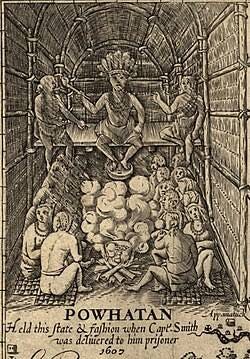
For 12,000 years, Native Americans in Virginia lived and governed the lands we would come to know as Richmond. In the late 1500s, Wahunsenacawh, Chief Powhatan, led the Powhatans and inherited control over the Powhatan, the Youghtanunds, the Mattaponis, and the Pamunkey tribes. As a successful leader, he expanded his power from 28 tribes to 32, establishing the Powhatan Chiefdom. This chiefdom covered land from the south of the James River to the Potomac River, and parts of the eastern shore called Tsenacommacah, covering an area of 100 miles by 100 miles. Before the English arrived, some sources estimate that at least 25,000 people lived in the tribe.
The Powhatan seat of power was Werowocomoco, located along the York River’s Purtan Bay in modern-day Gloucester County, Virginia. Archaeological evidence indicates human occupation dating to around 6,000-8,000 years ago. This place has long been associated with Native power in the region, as its name, translated from Algonquian, means “Place of Leadership.” Chief Powhatan was a leader among chiefs; each tribe had a chief, but Chief Powhatan ruled them and required them to pay tribute.
First European Contact.
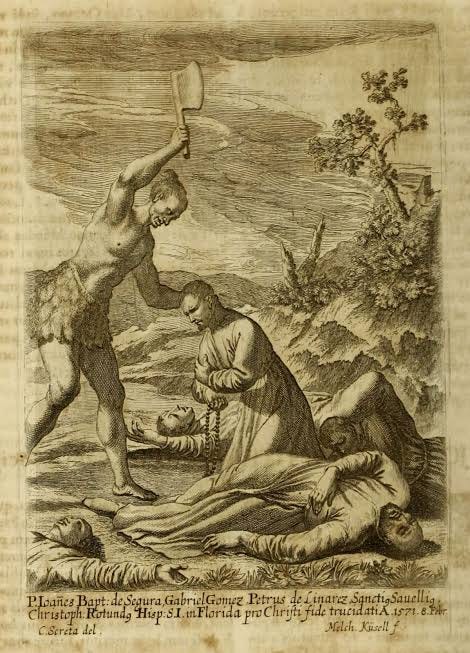
In 1570, the Spanish sought to expand their territories in the Americas to include the modern-day Chesapeake Bay. Part of the reason they wished to expand was to bring Catholicism to the Native Americans in the region. Juan Baptista de Segura was a Spanish-born priest andvice-provincial of the Jesuits in the Spanish province of La Florida. He, along with Pacquiquineo, a converted Native American, and several Jesuit priests, established Ajacan Mission. Its exact location remains unclear, as archaeologists have yet to recover it. Pacquiquineo had been guiding the Jesuit priests, but sometime in late 1570 or early 1571, he rejoined his people and helped attack the mission. Everyone was killed save for the 13-year-old altar boy, who was eventually recaptured by Spanish Forces, who decided to abandon the hope of establishing the region for the Spanish.
The British are Coming!

In 1606, the Virginia Company of London was granted its first charter, formal permission from King James I, to colonize North America. This was a private company settlement with goals for colonizing the “New World”: to find riches like gold and silver, establish new territory for England, create trade routes to reduce England’s dependence on foreign resources, and bring Christianity to the Natives. 105 men and boys sailed for Virginia in 1606 and landed in Powhatan-occupied territory. This did not stop the English from claiming the land for their own use and beginning a settlement of Jamestown.
However, this did not mean that the English settlers were doing well. Relations with the Powhatan were tenuous, and the settlers were not prepared for the vastly different environment. Most settlers were upper-class merchants and lacked the skills to produce their own food or build the settlement. They were constantly on the edge of starvation and ruin.
In the winter of 1607, Captain Smith was captured by the Powhatan and taken to Werowocomoco to be brought before Chief Powhatan. By the spring of 1608, Captain Smith and Chief Powhatan had established a peaceful relationship, and trade began between the Chiefdom and Jamestown. Captain John Smith, acting as a de facto leader, instituted a “no work, no food” policy, forcing everyone in the settlement to pull their weight because these upper-class men were unwilling to work for their survival.
In 1609, King James I granted a second charter to the Virginia Company, finally giving Jamestown governance under a strong Governorship, though the office wouldn’t be filled until Sir Thomas Gates and Lord De La Warr arrived the following year. Unfortunately for the Powhatan, this allowed the English presence to grow stronger in America and raised tensions among colonists and Natives. Later that year, Chief Powhatan left Werowocomoco and moved his people to Orapax, near present-day Richmond. He did this to stop further English encroachment into his domain.
In May of 1611, the Virginia Company instructed Sir Thomas Dale to establish a secure and healthy area for a new town and principal seat for the settlement. Dale moved up the James River to what is now modern-day Chester, VA, now a suburb of the greater Richmond area.
This would be the first English settlement in the Richmond area. The town and fort were called Henricus, named for Henry Frederick, the Prince of Wales. This further incursion into Powhatan territory was unwelcome, and in 1622, Opechancanough led a coordinated attack that devastated the colony’s outlying settlements, killing hundreds and sparing Jamestown only because of a last-minute warning
After the Indian Massacre of 1622, a tiny village would emerge from a nearby tobacco plantation owned by John Rolfe, who was married to Pocahontas. Varina is now located in modern-day Henrico County, VA, north of the James River, and is part of the Greater Richmond area.
In 1624, King James I revoked the Virginia Company’s charter and declared Virginia a royal colony. This distinction shaped Virginia’s development. Before then, it was a privately owned and operated business settlement subject to English Law. But settlements in the New World were not technically under direct English government and thus fell into a legal gray zone. Once Virginia was declared a Royal Colony, it received military protection and a political and governmental structure, and the colonists became English subjects.
In 1634, the crown divided up the colony into eight shires: James City, Henrico, Charles City, Elizabeth City, Warwick River, Warrosquyoake (later called Isle of Wight), Charles River, and Accawmack.
As the English expanded, the Powhatan tribe continued to try to push them back. A major offensive on April 18, 1644, was launched against the English settlements, resulting in the deaths of several hundred colonists. The James River Fall Line was settled in 1644 with the creation of Fort Charles, along with several other forts in the region, in response to Native attacks. The conflict ended with the Treaty of 1646, which forced the Powhatan Confederacy to recognize English sovereignty and pay tribute to the King.
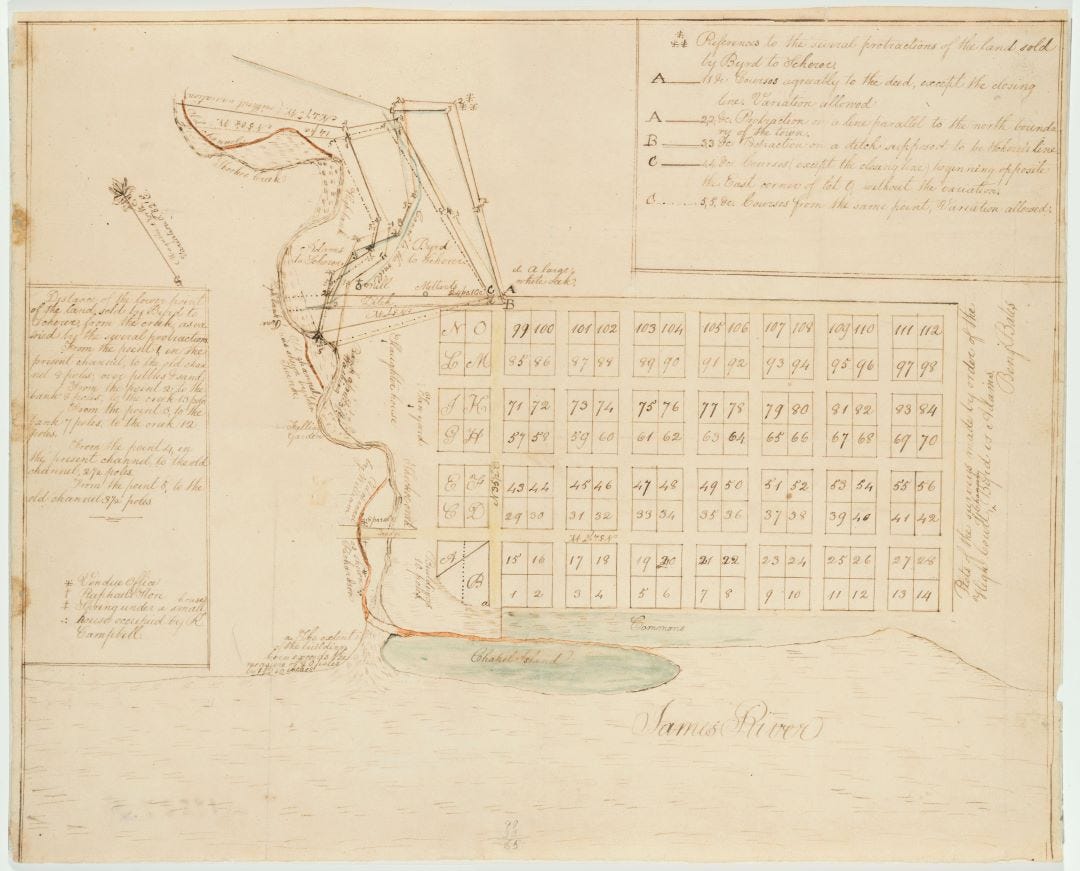
William Byrd I inherited land in Virginia from a family member around the Falls of the James. Byrd intended to create an international trading center in the region. Byrd wanted to add water mills and a trading house, and he partnered with his neighbor Nathaniel Bacon.
Bacon and Byrd’s relationship worked well until tensions rose between colonists seeking to expand their land and Natives resisting that expansion. The English crown had a series of governmental shake-ups and wars with European forces. They did not want to create another conflict with the Powhatan.
Things came to a head in 1675, when Doeg Indians took pigs from an English Virginian farm. The man and the Natives were in the midst of a trade dispute. The Virginian asked the local militia for help to deal with the Native and get his property back. The militia mistakenly killed 14 Susquehannock Indians, a tribe located in Maryland that had been on good terms with the Virginia government up until then. However, upon hearing about the death of their people, the Susquehannock immediately retaliated, killing several Virginians.
Colonists who wanted war to expand English control of the land took this as an opportunity to push for war. Virginia Governor William Berkeley did not want to fight another colonial conflict and tried to pursue diplomacy, sticking with the Treaty of 1646, in which the tribal entities were subjects to the Crown.
In Nathaniel Bacon, those who wished to pursue a war with the Natives had found a champion. Bacon was well connected and even served Berkeley on the governor’s council. However, Berkeley’s intention to stick with the Treaty brought the men to an impasse. Bacon began recruiting supporters among the colony’s lower classes, who were unhappy about falling tobacco prices and local taxation. These men wanted lower taxes, elections held for the House of Burgesses, an extension of voting to all free men (not just landed gentry), and the ability to wage war with all of the Native peoples in the area. Bacon also promised enslaved and indentured individuals freedom if they joined his cause.
While Bacon was in charge, these ragtag colonists gave the English a good fight. Both sides had victories and defeats. However, once Bacon passed away from likely dysentery, Bacon’s men began to falter without a leader. This left the colony more unstable and worsened English relations with local Native groups.
Byrd stayed loyal to Governor Berkeley, which helped him gain more political opportunities. In 1679, the General Assembly met to expand Byrd’s holdings and help him stabilize the region.
Byrd I died in 1704, leaving the land to his son, William Byrd II. He expanded the land and established the town of Richmond on the north side of the James River in 1733, and the General Assembly formally recognized the town in 1742.
End of Part 1
From the settlement of Jamestown to the founding of Richmond as a town would take about 126 years. In that time, there was a mission built and destroyed, starvation, wars between the Powhatan and Virginians, governments created, and open rebellion. And that is all before Richmond was founded, became a state capital, and eventually the capital of rebellion. Join me next time as we discuss Richmond’s early days, starting with the history of Shockoe Bottom.
Sources:
450th Commemoration of Ajacán – the Spanish Mission of 1570 | Blog | Jamestown-Yorktown Foundation, VA. https://www.jyfmuseums.org/Home/Components/News/News/55/148. Accessed 18 Aug. 2026.
A History of Bacons Rebellion in Six Sources | Jamestown-Yorktown Foundation, VA. https://www.jyfmuseums.org/learn/research-and-collections/essays/a-history-of-bacons-rebellion-in-six-sources. Accessed 19 Aug. 2026.
Bacon’s Rebellion | Historic Jamestowne. https://historicjamestowne.org/history/bacons-rebellion/. Accessed 19 Aug. 2026.
Bacon’s Rebellion » Henrico County, Virginia. https://henrico.gov/history/colonial-era/bacons-rebellion/. Accessed 19 Aug. 2026.
Colonial Era » Henrico County, Virginia. https://henrico.gov/history/colonial-era/. Accessed 19 Aug. 2026.
Frontier Forts in Virginia. https://www.virginiaplaces.org/military/frontierforts.html. Accessed 19 Aug. 2026.
Gallivan, Martin D. The Powhatan Landscape: An Archaeological History of the Algonquian Chesapeake. University Press of Florida, 2018. DOI.org (Crossref), https://doi.org/10.5744/9780813062860.
Gottlieb, Matthew S. “Richmond during the Colonial Period.” Encyclopedia Virginia, https://encyclopediavirginia.org/entries/richmond-during-the-colonial-period/. Accessed 19 Aug. 2026.
Henricus History | Chesterfield County, VA. https://www.chesterfield.gov/5969/Henricus-History. Accessed 19 Aug. 2026.
“Historic Richmond, Virginia | History | Research Starters | EBSCO Research.” EBSCO, https://www.ebsco.com/. Accessed 18 Aug. 2026.
History of Jamestown | Jamestown-Yorktown Foundation, VA. https://www.jyfmuseums.org/visit/jamestown-settlement/history-of-jamestown. Accessed 18 Aug. 2026.
Huber, Margaret Williamson. “Powhatan (d. 1618).” Encyclopedia Virginia, https://encyclopediavirginia.org/entries/powhatan-d-1618/. Accessed 18 Aug. 2026.
Hughes, Amanda. “Royal, Self-Governing, and Proprietary Colonies: Advancing From British Rule Toward American Independence.” Constituting America, 7 June 2022, https://constitutingamerica.org/90day-aer-royal-self-governing-and-proprietary-colonies-advancing-from-british-rule-toward-american-independence-guest-essayist-tom-hand/.
Long, Thomas L. “William Byrd (1674–1744).” Encyclopedia Virginia, https://encyclopediavirginia.org/entries/byrd-william-1674-1744/. Accessed 19 Aug. 2026.
Nation, The Powhatan. “The Powhatan Nation.” The Powhatan Nation, https://powhatannation.us/history. Accessed 18 Aug. 2026.
Quitt, Martin H. “William Byrd (ca. 1652–1704).” Encyclopedia Virginia, https://encyclopediavirginia.org/entries/byrd-william-ca-1652-1704/. Accessed 19 Aug. 2026.
“Richmond, Virginia’s History Timeline -.” The Valentine Museum, https://thevalentine.org/explore/richmond-stories/interactive-timeline/. Accessed 18 Aug. 2026.
Rountree, Helen C. Pocahontas’s People: The Powhatan Indians of Virginia Through Four Centuries. University of Oklahoma Press, 1990.
Stepping Back in Time at Henricus Historical Park (U.S. National Park Service). https://www.nps.gov/articles/000/stepping-back-in-time-at-henricus-historical-park.htm. Accessed 19 Aug. 2026.
The 1619 Landing — Virginia’s First Africans Report & FAQs | Hampton, VA - Official Website. https://www.hampton.gov/3580/The-1619-Landing-Report-FAQs. Accessed 19 Aug. 2026.
The Third Anglo-Powhatan War (1644-46). https://www.virginiaplaces.org/nativeamerican/thirdanglopowhatan.html. Accessed 19 Aug. 2026.
Tuckahoe, Historic. “Indigenous Peoples’ of Tuckahoe and the Richmond Area.” Historic Tuckahoe, 12 Oct. 2020, https://www.visithistorictuckahoe.com/indigenous-peoples-of-tuckahoe-and-the-richmond-area/.
Uncovering Powhatan’s Empire | National Endowment for the Humanities. https://www.neh.gov/humanities/2007/januaryfebruary/feature/uncovering-powhatan%E2%80%99s-empire. Accessed 18 Aug. 2026.
“Virginia Counties 1634–1640.” Encyclopedia Virginia, https://encyclopediavirginia.org/5737hpr-91fe5eb6aa7ae93/. Accessed 19 Aug. 2026.
Werowocomoco Archeological Site – DHR. https://www.dhr.virginia.gov/historic-registers/036-5049/. Accessed 18 Aug. 2026.
Wolfe, Brendan. “Juan Baptista de Segura (1529–1571).” Encyclopedia Virginia, https://encyclopediavirginia.org/entries/segura-juan-baptista-de-1529-1571/. Accessed 19 Aug. 2026.
Yorktown, Mailing Address: P. O. Box 210, and VA 23690 Contact Us. Werowocomoco - Captain John Smith Chesapeake National Historic Trail (U.S. National Park Service). https://www.nps.gov/cajo/planyourvisit/werowocomoco.htm. Accessed 18 Aug. 2026.
Yorktown, Mailing Address: P. O. Box 210, and VA 23690 Phone: 757 898-2410 Contact Us. The Virginia Company of London - Historic Jamestowne Part of Colonial National Historical Park (U.S. National Park Service). https://www.nps.gov/jame/learn/historyculture/the-virginia-company-of-london.htm. Accessed 19 Aug. 2026.