
Sweet Massa (Massa Sovada)
"I remember, I remember Everything."

It was the early 1990s, and there were no computers, cellphones, or even corded phones, not in the primarily rural Wake County, North Carolina. I am in fourth grade, and I am not adjusting well to my new school. The classes are getting more difficult. They added a new kind of homework. Long-term Projects, I then discovered my ADHD Achilles Heel. No matter how many times I wrote stuff down, I would always forget about the project.
The first project was to create a hat or something representing the state of North Carolina, and we had two weeks to do it. I did it the night before, after my teacher reminded us that it was due the next day. My bio mom informed me that she did not know how to help and that it was not her problem. I ended up going to school with a hat made out of paper towels, because I had no construction paper or anything. I used some staples and just tried to put some pine needles on it and a Pepsi sticker on it. It was sad and embarrassing.
As you can imagine, this resulted in the first of many parent-teacher conferences where, ‘Kelly is not meeting expectations when it comes to homework and projects.’ If I had died at 18, that would have been my epitaph. ‘Kelly knows the information, but performs poorly on tests and written work.’ That should have been my yearbook quote.
My Dad, for all his desire, could not be there to help me. He had to work, and it was shift work, which meant he had little to no flexibility. My bio mother was less than helpful, so my Dad turned to his sister. Aunt Rose had an associate’s degree and wanted me to be excited about school and education. She happily agrees to help, and I hand her my new long-term project, Food of My Family. I was supposed to recreate a family recipe that was traditional to our ethnicity/ancestry.
My Aunt Rose and I planned to draw from my maternal heritage because it would be different from a lot of other kids in school. My Aunt Rose and I headed to the Library in Apex to try to find anything we could about the Azores, their culture, religion, and food. She also encourages me to speak to my maternal grandfather about his childhood experiences.
I worked up the courage to ask my Grandpa Kenny, a short, dark, and hairy man who could be intimidating, at least to a tiny, shy elementary kid. He had a wicked sense of humor and would often make weird sounds instead of real-word responses. (I would come to appreciate his humor once I got older; as a kid, I couldn’t wrap my head around it.) I asked him about his childhood and what it meant to be Azorean. He answered my questions with deflecting humor and a story about poverty in New Bedford, Mass. Grandpa would always get a bit evasive when it came to his childhood. I had the feeling that he was trying to distance himself from that time in his life. However, he does have delicious memories about the sweet bread his mother and aunts would make for Easter.
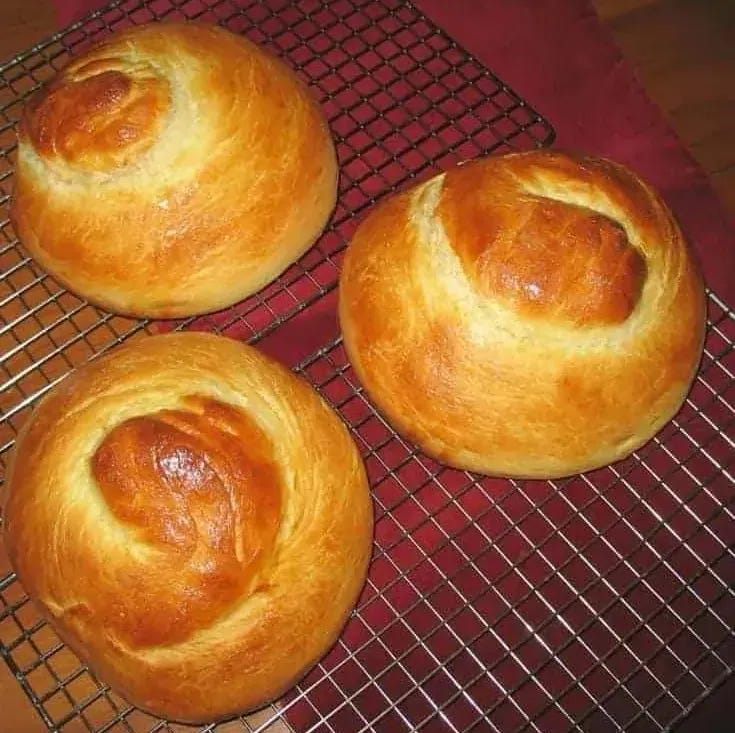
I return to my Aunt Rose, and we head back to the library to find a recipe for this Portuguese Sweet Bread. The week the project was due, I got to stay with my Aunt Rose. We spent the weekend making the dough and shaping the bread into a snail-like shape, just like the loaf featured in the encyclopedia. Making a small sample loaf for just us to share at home.
It is the first time that I felt proud and prepared to be a school. The bread was slightly sweet and fluffy as I reconnected with a part of my ancestry that chance had robbed me of. I felt proud, empowered, and like I could learn or do anything. I remember my Aunt would often remind me that education is the most powerful tool a woman has in her arsenal. It teaches you how to think and to solve problems. It is something no one can ever take away from you, because you did the work, you earned it.
lovely story!