
A Mammoth Sight
On the Road: The Mammoth Site of Hot Springs, SD

Want to hear a terrible joke? Okay. If you want to piss off an archaeologist, all you have to do is ask them what their favorite dinosaur is. Every single time, you will get a pause, a sigh, and then their answer. We are archaeologists, not arseholes, so we will answer with our favorite dino. Honestly, though, it is a bit embarrassing how often museums, books, TV, and people in general don’t understand the massive difference between archaeology and paleontology. Archaeology is the study of past human cultures and societies through physical evidence of human interaction. Think everything from prehistoric trash to buildings to human remains. Paleontology is the science that deals with life in past geologic periods, as known from fossil remains, such as dinosaurs. We are from two different disciplines: archaeology in the United States falls under anthropology (unless we are talking about Classical Archaeology, which falls under history). Paleontology falls under geology because it deals with deep time. What I tell my kids: “If it doesn’t involve humans, then it ain’t archaeology.”
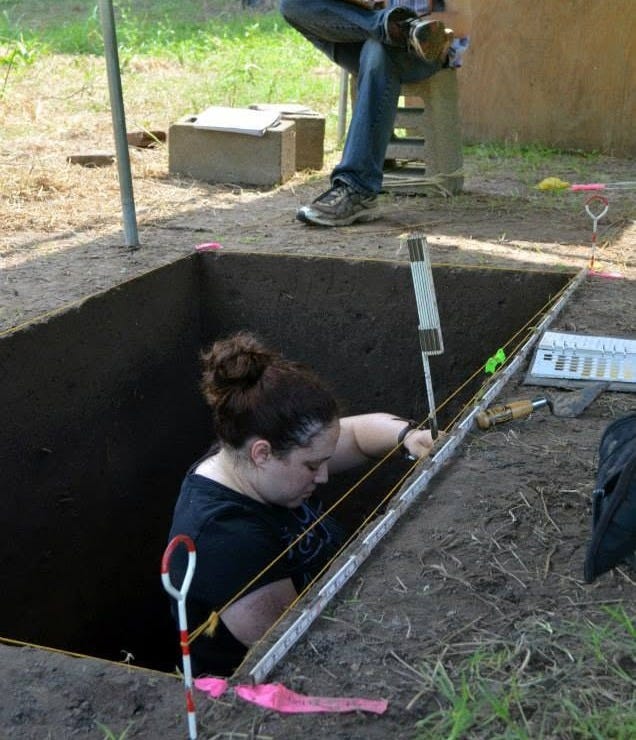
This doesn’t mean the two disciplines don’t ever cross paths. There are archaeologists and biological anthropologists who study human evolution (we are talking 7 million years ago (mya)+/-). They will often have some interaction and cross-study work done with paleontologists. While visiting friends in South Dakota this summer, I visited an active excavation site that is a perfect example of an interconnected paleontological and archaeological site. Known simply as the Mammoth Site, it is an enclosed, climate-controlled location you can visit anytime. It turns out that if you can control environmental factors, you can dig pretty much indefinitely. (Not that you would want to for many reasons.)
The Mammoth Site is a 501(c)(3) nonprofit that serves as a hub for research and education at every level. The program offers summer educational programming, internships, and visiting researcher options. The site itself dates from the Late Pleistocene, 190,000-140,000 years ago, and contains remains of Columbian mammoths, woolly mammoths, ancient camels, llamas, pronghorn antelopes, giant short-faced bears, wolves, coyotes, badgers, and various other small mammals and rodents. The site itself is rare because of the natural phenomena that created it. It was a lake formed by a hot spring during the last ice age, with lots of vegetation, but slippery, difficult terrain surrounding it. An animal would get a drink, swim, or try to eat the plants around the lake, and then fall into the water, which was extremely difficult to escape. The lake’s victims would eventually be covered by sediment, burying and preserving their skeletons until they were discovered in June of 1974.
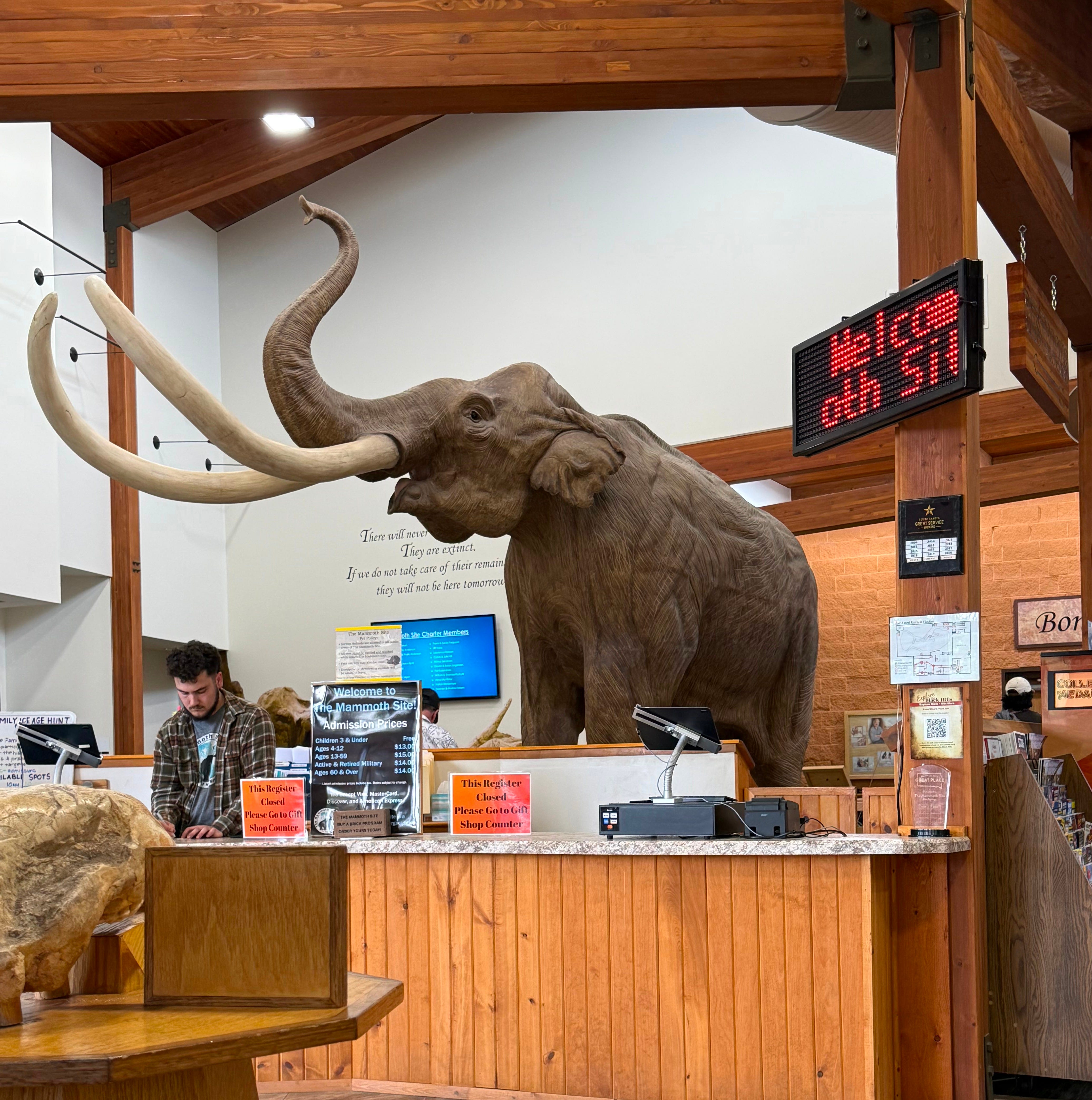
Landowner Phil Anderson was developing housing in the Hot Springs area when it was decided to level some of the hills. After heavy equipment driven by George Hanson unearthed a mammoth skeleton, Anderson decided to halt work on the land until a paleontologist could be contacted to excavate the site and determine its nature. Anderson contacted several universities, but received very little response. Thankfully, George Hanson’s son, Dan, had attended Chadron State College and had connections with the geology department. Dan Hanson showed his former college professor, Larry Agenbroad, Ph.D., a sample of the bones unearthed by his father. Agenbroad decided it was worth the time to check out the Hot Springs site.
The initial investigation of what the builders had uncovered showed there were at least four and as many as six mammoths, and Agenbroad knew there had to be more just beneath the surface. Knowing that the excavation season was soon ending, and that winter snows could be detrimental to the exposed mammoth bones, and that halting a building project would cost a considerable amount of money, Agenbroad had to send an excavation team immediately.
Agenbroad was already working with his teams on two different sites, Arizona and southeastern Nebraska, so he sent a colleague, Jim Mead, Ph.D., along with some of his team members to quickly excavate and assess the size and scope of the Hot Springs site. Mead and his team worked to stabilize and protect the site.
It was decided that the following year, 1975, Agenbroad and Mead would lead a more focused excavation in Hot Springs. The results of the excavation and the growing interest among visitors led Phil Anderson to decide against developing 14 acres of land. Instead, he established the Mammoth Site of Hot Springs, SD, Inc. to protect and preserve the site for future generations of scientific researchers.
This site boasts amazing preservation; they even have intact hyoid bones, which are extremely rare. The Hot Springs site has proven useful for understanding the age at death of Columbian mammoths, their age distribution, and their relationships to the larger mammoth herds. It has driven discussion about mammoth social groups. In a 2013 article in the French publication PALEO, Sophie Louguet-Lefebvre discusses how the absence of juveniles at the site might indicate that most of the site’s victims were males isolated from the herd. The site’s overrepresentation of males might reflect how the matriarchal herd structure protected females and juveniles from environmental hazards such as the Hot Springs sinkhole, leaving solitary males most exposed.
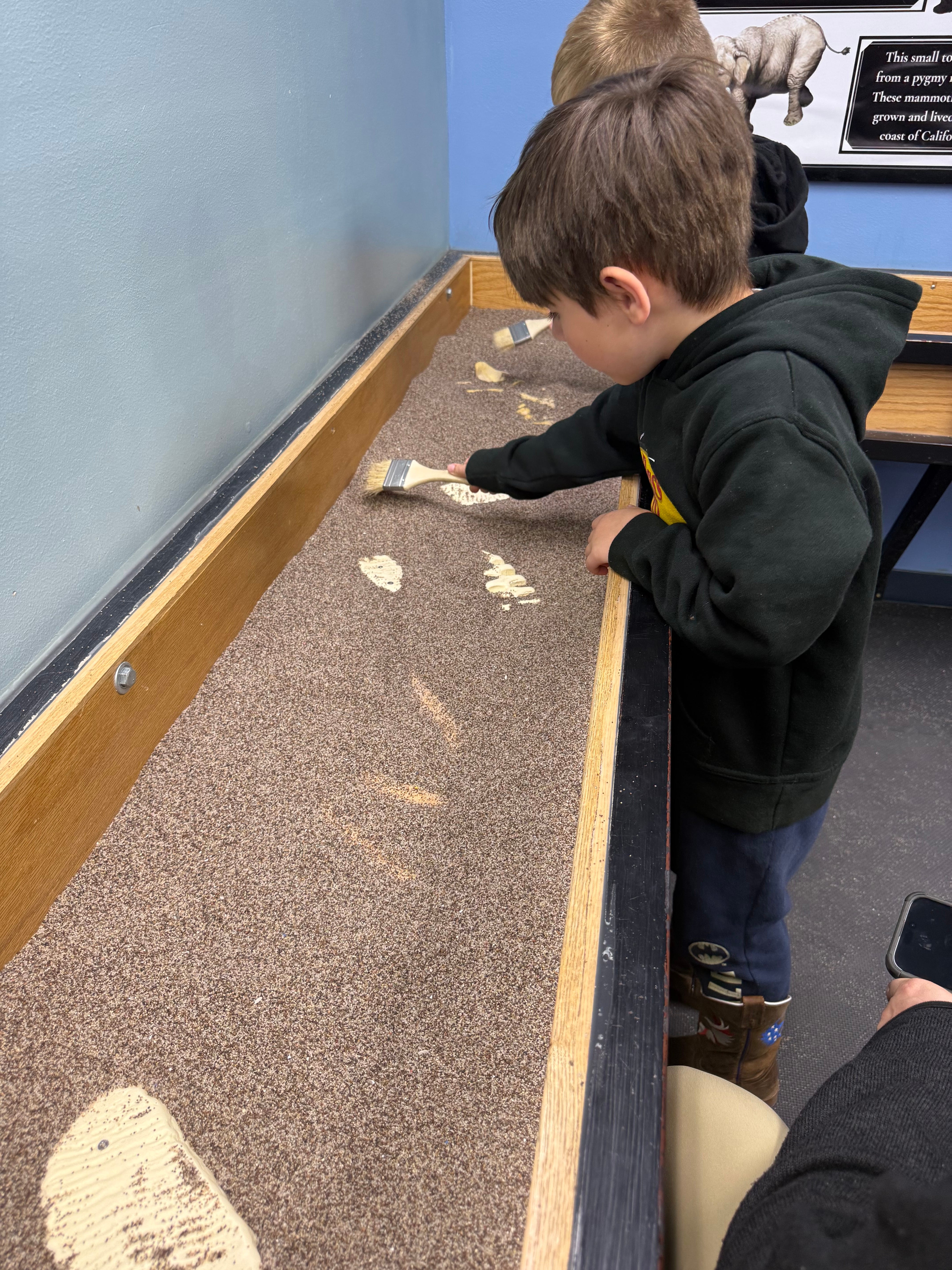
The Mammoth Site is educational and fun for the whole family, and a great way to introduce young academics to a working paleontological dig. The museum also includes several items associated with nearby kill and processing sites for mammoths, where humans would have left material remains alongside the mammoth remains. They also include the difference between archaeologists and paleontologists, which made me far happier than I should have been.
It truly was a pleasure seeing a site open to visitors that had a strong academic focus. If you find yourself in the Black Hills, I would highly recommend visiting the Mammoth Site. It gives the average person a true representation of an academic excavation and what we can learn from studying the past.
Sources:
History - The Mammoth Site. 31 May 2022, https://mammothsite.org/history/.
Isotopic Analysis and Mobility Mapping of Mammuthus Columbi from the Mammoth Site in South Dakota - ProQuest. https://www.proquest.com/openview/90bf0e71ec811fcf02ccb765278ba79f/1?pq-origsite=gscholar&cbl=18750&diss=y. Accessed 25 June 2026.
Louguet-Lefebvre, Sophie. “The Columbian Mammoths from the Upper Pleistocene of Hot Springs (South Dakota, United States).” PALEO. Revue d’archéologie Préhistorique, no. 24, Dec. 2013, pp. 149–71. journals.openedition.org, https://doi.org/10.4000/paleo.2861.